Born in
Bonn, then the capital of the
Electorate of Cologne and part of the
Holy Roman Empire, Beethoven displayed his musical talents at an early age and was taught by his father
Johann van Beethoven and by composer and conductor
Christian Gottlob Neefe. At the age of 21 he moved to
Vienna, where he began studying composition with
Joseph Haydn and gained a reputation as a virtuoso pianist. He lived in Vienna until his death. By his late 20s his hearing began to deteriorate, and by the last decade of his life he was almost completely deaf. In 1811 he gave up conducting and performing in public but continued to compose; many of his most admired works come from these last 15 years of his life.
Biography
Background and early life
Beethoven was the grandson of
Ludwig van Beethoven (1712–73), a musician from the town of
Mechelen in the
Duchy of Brabant in the
Flemish region of what is now
Belgium, who at the age of twenty moved to Bonn.
[2] Ludwig (he adopted the
German cognate of the
Dutch Lodewijk) was employed as a
bass singer at the court of the
Elector of Cologne, eventually rising to become, in 1761,
Kapellmeister (music director) and thereafter the pre-eminent musician in Bonn. The portrait he commissioned of himself towards the end of his life remained proudly displayed in his grandson's rooms as a talisman of his musical heritage. Ludwig had one son,
Johann (1740–1792), who worked as a tenor in the same musical establishment and gave keyboard and
violin lessons to supplement his income.
[2] Johann married
Maria Magdalena Keverich in 1767; she was the daughter of Johann Heinrich Keverich (1701–1751), who had been the head chef at the court of the
Archbishopric of Trier.

Prince-Elector's Palace(
Kurfürstliches Schloss) in Bonn, where the Beethoven family had been active since the 1730s
Beethoven was born of this marriage in Bonn. There is no authentic record of the date of his birth; however, the registry of his baptism, in a
Catholic service at the Parish of St. Regius on 17 December 1770, survives.
[6] As children of that era were traditionally baptised the day after birth in the Catholic Rhine country, and it is known that Beethoven's family and his teacher
Johann Albrechtsberger celebrated his birthday on 16 December, most scholars accept 16 December 1770 as Beethoven's date of birth. Of the seven children born to Johann van Beethoven, only Ludwig, the second-born, and two younger brothers survived infancy.
Kaspar Anton Karl was born on 8 April 1774, and Nikolaus Johann, the youngest, was born on 2 October 1776.
[9]
Beethoven's first music teacher was his father. He later had other local teachers: the court
organist Gilles van den Eeden (d. 1782), Tobias Friedrich Pfeiffer (a family friend, who provided keyboard tuition), and Franz Rovantini (a relative, who instructed him in playing the violin and
viola).
[2] From the outset his tuition regime, which began in his fifth year, was harsh and intensive, often reducing him to tears; with the involvement of the insomniac Pfeiffer there were irregular late-night sessions with the young Beethoven being dragged from his bed to the keyboard. Beethoven's musical talent was obvious at a young age. Johann, aware of
Leopold Mozart's successes in this area (with his son
Wolfgang and daughter
Nannerl), attempted to promote his son as a
child prodigy, claiming that Beethoven was six (he was seven) on the posters for Beethoven's first public performance in March 1778.
Some time after 1779, Beethoven began his studies with his most important teacher in Bonn,
Christian Gottlob Neefe, who was appointed the Court's Organist in that year. Neefe taught Beethoven composition, and by March 1783 had helped him write his first published composition: a set of keyboard variations (
WoO 63).
[9] Beethoven soon began working with Neefe as assistant organist, at first unpaid (1781), and then as a paid employee (1784) of the court chapel conducted by the Kapellmeister
Andrea Luchesi. His
first three piano sonatas, named "
Kurfürst" ("Elector") for their dedication to the Elector
Maximilian Friedrich (1708–1784), were published in 1783. Maximilian Frederick noticed Beethoven's talent early, and subsidised and encouraged the young man's musical studies.

A portrait of the 13-year-old Beethoven by an unknown Bonn master (
c. 1783)
Maximilian Frederick's successor as the Elector of Bonn was
Maximilian Francis, the youngest son of Empress
Maria Theresa of Austria, and he brought notable changes to Bonn. Echoing changes made in Vienna by his brother
Joseph, he introduced reforms based on
Enlightenment philosophy, with increased support for education and the arts. The teenage Beethoven was almost certainly influenced by these changes. He may also have been influenced at this time by ideas prominent in
freemasonry, as Neefe and others around Beethoven were members of the local chapter of the
Order of the Illuminati.
In March 1787 Beethoven travelled to Vienna, possibly at another's expense, for the first time, apparently in the hope of studying with Mozart. The details of
their relationship are uncertain, including whether they actually met. Having learned that his mother was ill, Beethoven returned about two weeks after his arrival in Vienna. His mother died shortly thereafter, and his father lapsed deeper into
alcoholism. As a result, Beethoven became responsible for the care of his two younger brothers, and spent the next five years in Bonn.
Beethoven was introduced in these years to several people who became important in his life. Franz Wegeler, a young medical student, introduced him to the von Breuning family (one of whose daughters Wegeler eventually married). Beethoven often visited the von Breuning household, where he taught piano to some of the children. Here he encountered German and classical literature. The von Breuning family environment was less stressful than his own, which was increasingly dominated by his father's decline. Beethoven also came to the attention of
Count Ferdinand von Waldstein, who became a lifelong friend and financial supporter.
In 1789 Beethoven obtained a legal order by which half of his father's salary was paid directly to him for support of the family. He also contributed further to the family's income by playing
viola in the court orchestra. This familiarised Beethoven with a variety of operas, including three by Mozart that were performed at court in this period. He also befriended
Anton Reicha, a
flautist and violinist of about his own age who was a nephew of the court orchestra's conductor,
Josef Reicha.
From 1790 to 1792, Beethoven composed a significant number of works (none were published at the time, and most are now listed as
works without opus number) that demonstrated his growing range and maturity.
Musicologists have identified a theme similar to those of his
Third Symphony in a set of variations written in 1791. It was probably on Neefe's recommendation that Beethoven received his first commissions. The municipal leaders in Bonn had commissioned cantatas to mark the occasion of the death in 1790 of
Franz Joseph II and the subsequent accession of
Leopold II as
Holy Roman Emperor. The two
Emperor Cantatas (WoO 87, WoO 88) Beethoven scored were never performed at the time and they remained lost until the 1880s. But they were, according to
Brahms, distinctively "Beethoven through and through" and as such prophetic of the tragic style which would mark his music as distinct from the classical tradition.
[22]
Beethoven was probably first introduced to
Joseph Haydn in late 1790, when the latter was travelling to London and stopped in Bonn around Christmas time. A year and a half later, they met in Bonn on Haydn's return trip from London to Vienna in July 1792, and it is likely that arrangements were made at that time for Beethoven to study with the old master.
Establishing his career in Vienna
With the Elector's help, Beethoven left Bonn for Vienna in November 1792, amid rumours of
war spilling out of France; he learned shortly after his arrival that his father had died. Mozart had also recently died. Count Waldstein, in his farewell note to Beethoven, wrote: "Through uninterrupted diligence you will receive Mozart's spirit through Haydn's hands." Over the next few years, Beethoven responded to the widespread feeling that he was a successor to the recently deceased Mozart by studying that master's work and writing works with a distinctly Mozartean flavour.

Portrait of Beethoven as a young man by Carl Traugott Riedel (1769–1832)
Beethoven did not immediately set out to establish himself as a composer, but rather devoted himself to study and performance. Working under Haydn's direction,
[29] he sought to master
counterpoint. He also studied violin under
Ignaz Schuppanzigh. Early in this period, he also began receiving occasional instruction from
Antonio Salieri, primarily in Italian vocal composition style; this relationship persisted until at least 1802, and possibly 1809. With Haydn's departure for England in 1794, Beethoven was expected by the Elector to return home. He chose instead to remain in Vienna, continuing his instruction in counterpoint with
Johann Albrechtsberger and other teachers. Although his stipend from the Elector expired, a number of Viennese noblemen had already recognised his ability and offered him financial support, among them
Prince Joseph Franz Lobkowitz,
Prince Karl Lichnowsky, and Baron
Gottfried van Swieten.
By 1793, Beethoven had established a reputation as an improviser in the salons of the nobility, often playing the
preludes and
fugues of
J. S. Bach's
Well-Tempered Clavier.
[33] His friend
Nikolaus Simrock had begun publishing his compositions; the first are believed to be a set of variations (WoO 66). By 1793, he had established a reputation in Vienna as a piano virtuoso, but he apparently withheld works from publication so that their publication in 1795 would have greater impact. Beethoven's first public performance in Vienna was in March 1795, a concert in which he first performed one of his
piano concertos. It is uncertain whether this was the
First or
Second. Documentary evidence is unclear, and both concertos were in a similar state of near-completion (neither was completed or published for several years). Shortly after this performance, he arranged for the publication of the first of his compositions to which he assigned an
opus number, the
three piano trios, Opus 1. These works were dedicated to his patron Prince Lichnowsky, and were a financial success; Beethoven's profits were nearly sufficient to cover his living expenses for a year.
Musical maturity
Beethoven composed his
first six string quartets (Op. 18) between 1798 and 1800 (commissioned by, and dedicated to, Prince Lobkowitz). They were published in 1801. With premieres of his
First and
Second Symphonies in 1800 and 1803, Beethoven became regarded as one of the most important of a generation of young composers following Haydn and Mozart. He also continued to write in other forms, turning out widely known
piano sonatas like the "
Pathétique" sonata (Op. 13), which Cooper describes as "surpass[ing] any of his previous compositions, in strength of character, depth of emotion, level of originality, and ingenuity of motivic and tonal manipulation." He also completed his
Septet (Op. 20) in 1799, which was one of his most popular works during his lifetime.
For the premiere of his
First Symphony, Beethoven hired the
Burgtheater on 2 April 1800, and staged an extensive programme of music, including works by Haydn and Mozart, as well as his Septet, the First Symphony, and one of his piano concertos (the latter three works all then unpublished). The concert, which the
Allgemeine musikalische Zeitung described as "the most interesting concert in a long time," was not without difficulties; among the criticisms was that "the players did not bother to pay any attention to the soloist."
Mozart and Haydn were undeniable influences. For example, Beethoven's
quintet for piano and winds is said to bear a strong resemblance to
Mozart's work for the same configuration, albeit with his own distinctive touches. But Beethoven's melodies, musical development, use of modulation and texture, and characterisation of emotion all set him apart from his influences, and heightened the impact some of his early works made when they were first published. By the end of 1800, Beethoven and his music were already much in demand from patrons and publishers.
In May 1799, Beethoven taught piano to the daughters of Hungarian Countess Anna Brunsvik. During this time, Beethoven fell in love with the younger daughter
Josephine[43] who has therefore been identified as one of the more likely candidates for the addressee of his letter to the "
Immortal Beloved" (in 1812). Shortly after these lessons, Josephine was married to Count Josef Deym. Beethoven was a regular visitor at their house, continuing to teach Josephine, and playing at parties and concerts. Her marriage was by all accounts happy (despite initial financial problems),
[44] and the couple had four children. Her relationship with Beethoven intensified after Deym died suddenly in 1804.
Beethoven had few other students. From 1801 to 1805, he tutored
Ferdinand Ries, who went on to become a composer and later wrote
Beethoven remembered, a book about their encounters. The young
Carl Czerny studied with Beethoven from 1801 to 1803. Czerny went on to become a renowned music teacher himself, instructing
Franz Liszt, and gave on 11 February 1812 the Vienna premiere of Beethoven's
fifth piano concerto (the "Emperor").
Beethoven's compositions between 1800 and 1802 were dominated by two large-scale orchestral works, although he continued to produce other important works such as the piano sonata
Sonata quasi una fantasia known as the "Moonlight Sonata". In the spring of 1801 he completed
The Creatures of Prometheus, a
ballet. The work received numerous performances in 1801 and 1802, and Beethoven rushed to publish a piano arrangement to capitalise on its early popularity. In the spring of 1802 he completed the
Second Symphony, intended for performance at a concert that was cancelled. The symphony received its premiere instead at a subscription concert in April 1803 at the
Theater an der Wien, where Beethoven had been appointed composer in residence. In addition to the Second Symphony, the concert also featured the First Symphony, the
Third Piano Concerto, and the
oratorio Christ on the Mount of Olives. Reviews were mixed, but the concert was a financial success; Beethoven was able to charge three times the cost of a typical concert ticket.
Beethoven's business dealings with publishers also began to improve in 1802 when his brother Kaspar, who had previously assisted him casually, began to assume a larger role in the management of his affairs. In addition to negotiating higher prices for recently composed works, Kaspar also began selling some of Beethoven's earlier unpublished works, and encouraged Beethoven (against the latter's preference) to also make arrangements and transcriptions of his more popular works for other instrument combinations. Beethoven acceded to these requests, as he could not prevent publishers from hiring others to do similar arrangements of his works.
Loss of hearing
Beethoven is reported to have dated his hearing loss from a fit he suffered in 1798 induced by a rage at the interruption of his work—having fallen over, he got up to find himself deaf. His hearing only ever partially recovered and, during its gradual decline, was impeded by a severe form of
tinnitus. As early as 1801, he wrote to friends describing his symptoms and the difficulties they caused in both professional and social settings (although it is likely some of his close friends were already aware of the problems).
Beethoven, on the advice of his doctor, lived in the small Austrian town of
Heiligenstadt, just outside Vienna, from April to October 1802 in an attempt to come to terms with his condition. There he wrote his
Heiligenstadt Testament, a letter to his brothers which records his thoughts of suicide due to his growing deafness and records his resolution to continue living for and through his art. Over time, his hearing loss became profound: at the end of the premiere of his
Ninth Symphony in 1824, he had to be turned around to see the tumultuous applause of the audience because he could hear neither it nor the orchestra. Beethoven's hearing loss did not prevent him from composing music, but it made playing at concerts—a lucrative source of income—increasingly difficult. After a failed attempt in 1811 to perform his own
Piano Concerto No. 5 (the "Emperor"), which was premiered by his student
Carl Czerny, he never performed in public again until he directed the premiere performance of the Ninth Symphony in 1824, which involved him giving cues to conductor Michael Umlauf.
[54]
A large collection of Beethoven's hearing aids, such as a special
ear horn, can be viewed at the
Beethoven House Museum in Bonn, Germany. Despite his obvious distress, Czerny remarked that Beethoven could still hear speech and music normally until 1812.
[55] Around 1814 however, by the age of 44, Beethoven was almost totally deaf, and when a group of visitors saw him play a loud arpeggio of thundering bass notes at his piano remarking, "Ist es nicht schön?" (Is it not beautiful?), they felt deep sympathy considering his courage and sense of humour (he lost the ability to hear higher frequencies first).
As a result of Beethoven's hearing loss, his conversation books are an unusually rich written resource. Used primarily in the last ten or so years of his life, his friends wrote in these books so that he could know what they were saying, and he then responded either orally or in the book. The books contain discussions about music and other matters, and give insights into Beethoven's thinking; they are a source for investigations into how he intended his music should be performed, and also his perception of his relationship to art. Out of a total of 400 conversation books, it has been suggested that 264 were destroyed (and others were altered) after Beethoven's death by his secretary
Anton Schindler, who wished only an idealised biography of the composer to survive.
[57] However,
Theodore Albrecht contests the verity of Schindler's destruction of a large number of conversation books.
[58]
Patronage
While Beethoven earned income from publication of his works and from public performances, he also depended on the generosity of patrons for income, for whom he gave private performances and copies of works they commissioned for an exclusive period prior to their publication. Some of his early patrons, including Prince Lobkowitz and Prince Lichnowsky, gave him annual stipends in addition to commissioning works and purchasing published works.
In the autumn of 1808, after having been rejected for a position at the royal theatre, Beethoven received an offer from
Napoleon's brother
Jérôme Bonaparte, then king of
Westphalia, for a well-paid position as
Kapellmeister at the court in
Cassel. To persuade him to stay in Vienna, the Archduke Rudolph,
Prince Kinsky and Prince Lobkowitz, after receiving representations from the composer's friends, pledged to pay Beethoven a pension of 4000 florins a year. Only Archduke Rudolph paid his share of the pension on the agreed date. Kinsky, immediately called to military duty, did not contribute and soon died after falling from his horse. Lobkowitz stopped paying in September 1811. No successors came forward to continue the patronage, and Beethoven relied mostly on selling composition rights and a small pension after 1815. The effects of these financial arrangements were undermined to some extent by
war with France, which caused significant inflation when the government printed money to fund its war efforts.
[citation needed]
Middle period
Beethoven's return to Vienna from Heiligenstadt was marked by a change in musical style, and is now designated as the start of his middle or "heroic" period. According to Carl Czerny, Beethoven said, "I am not satisfied with the work I have done so far. From now on I intend to take a new way." This "heroic" phase was characterised by a large number of original works composed on a grand scale.
[64] The first major work employing this new style was the
Third Symphony in E flat, known as the
Eroica. This work was longer and larger in scope than any previous symphony. When it premiered in early 1805 it received a mixed reception. Some listeners objected to its length or misunderstood its structure, while others viewed it as a masterpiece.
|
|
composed during Beethoven's middle period
|
| Problems playing this file? See media help. |
The "middle period" is sometimes associated with a "heroic" manner of composing,
[66] but the use of the term "heroic" has become increasingly controversial in Beethoven scholarship. The term is more frequently used as an alternative name for the middle period.
[67] The appropriateness of the term "heroic" to describe the whole middle period has been questioned as well: while some works, like the Third and Fifth Symphonies, are easy to describe as "heroic", many others, like his
Symphony No. 6, Pastoral, are not.
[68]
Some of the middle period works extend the musical language Beethoven had inherited from Haydn and Mozart. The middle period work includes the Third through
Eighth Symphonies, the
Rasumovsky,
Harp and
Serioso string quartets, the
Waldstein and
Appassionata piano sonatas,
Christ on the Mount of Olives, the opera
Fidelio, the
Violin Concerto and many other compositions. During this time Beethoven's income came from publishing his works, from performances of them, and from his patrons. His position at the Theater an der Wien was terminated when the theatre changed management in early 1804, and he was forced to move temporarily to the suburbs of Vienna with his friend Stephan von Breuning. This slowed work on
Fidelio, his largest work to date, for a time. It was delayed again by the Austrian
censor, and finally premiered in November 1805 to houses that were nearly empty because of the
French occupation of the city. In addition to being a financial failure, this version of
Fidelio was also a critical failure, and Beethoven began revising it.
During May 1809, when the attacking forces of
Napoleon bombarded Vienna, according to Ferdinand Ries, Beethoven, very worried that the noise would destroy what remained of his hearing, hid in the basement of his brother's house, covering his ears with pillows.
The work of the middle period established Beethoven as a master. In a review from 1810, he was enshrined by
E. T. A. Hoffmann as one of the three great "
Romantic" composers; Hoffman called Beethoven's
Fifth Symphony "one of the most important works of the age."
Personal and family difficulties
Beethoven's love life was hampered by class issues. In late 1801 he met a young countess,
Julie ("Giulietta") Guicciardi through the Brunsvik family, at a time when he was giving regular piano lessons to
Josephine Brunsvik. Beethoven mentions his love for Julie in a November 1801 letter to his boyhood friend, Franz Wegeler, but he could not consider marrying her, due to the class difference. Beethoven later dedicated to her his
Sonata No. 14, now commonly known as the
Moonlight sonata or
Mondscheinsonate (in German).
His relationship with Josephine Brunsvik deepened after the death in 1804 of her aristocratic first husband, the Count Joseph Deym. Beethoven wrote Josephine 15 passionate love letters from late 1804 to around 1809/10. Although his feelings were obviously reciprocated, Josephine was forced by her family to withdraw from him in 1807. She cited her "duty" and the fact that she would have lost the custodianship of her aristocratic children had she married a commoner. After Josephine married Baron von Stackelberg in 1810, Beethoven may have proposed unsuccessfully to
Therese Malfatti, the supposed dedicatee of "
Für Elise"; his status as a commoner may again have interfered with those plans.
In the spring of 1811 Beethoven became seriously ill, suffering headaches and high fever. On the advice of his doctor, he spent six weeks in the
Bohemian spa town of
Teplitz. The following winter, which was dominated by work on the Seventh symphony, he was again ill, and his doctor ordered him to spend the summer of 1812 at the spa Teplitz. It is certain that he was at Teplitz when he wrote a love letter to his "
Immortal Beloved".
[75] The identity of the intended recipient has long been a subject of debate; candidates include Julie Guicciardi, Therese Malfatti, Josephine Brunsvik, and Antonie Brentano.
Beethoven visited his brother Johann at the end of October 1812. He wished to end Johann's cohabitation with Therese Obermayer, a woman who already had an illegitimate child. He was unable to convince Johann to end the relationship and appealed to the local civic and religious authorities. Johann and Therese married on 9 November.

Beethoven in 1814. Portrait by Louis-René Létronne.
In early 1813 Beethoven apparently went through a difficult emotional period, and his compositional output dropped. His personal appearance degraded—it had generally been neat—as did his manners in public, especially when dining. Beethoven took care of his brother (who was suffering from tuberculosis) and his family, an expense that he claimed left him penniless.
Beethoven was finally motivated to begin significant composition again in June 1813, when news arrived of the
defeat of one of Napoleon's armies at
Vitoria, Spain, by a coalition of forces under the
Duke of Wellington. This news stimulated him to write the battle symphony known as
Wellington's Victory. It was first performed on 8 December, along with his Seventh Symphony, at a charity concert for victims of the war. The work was a popular hit, probably because of its programmatic style, which was entertaining and easy to understand. It received repeat performances at concerts Beethoven staged in January and February 1814. Beethoven's renewed popularity led to demands for a revival of
Fidelio, which, in its third revised version, was also well received at its July opening. That summer he composed a piano sonata for the first time in five years (
No. 27, Opus 90). This work was in a markedly more
Romantic style than his earlier sonatas. He was also one of many composers who produced music in a patriotic vein to entertain the many heads of state and diplomats who came to the
Congress of Vienna that began in November 1814. His output of songs included his only
song cycle, "
An die ferne Geliebte," and the extraordinarily expressive second setting of the poem "An die Hoffnung" (Op. 94) in 1815. Compared to its first setting in 1805 (a gift for Josephine Brunsvik), it was "far more dramatic ... The entire spirit is that of an operatic scena."
Custody struggle and illness
Between 1815 and 1817 Beethoven's output dropped again. Beethoven attributed part of this to a lengthy illness (he called it an "inflammatory fever") that afflicted him for more than a year, starting in October 1816. Biographers have speculated on a variety of other reasons that also contributed to the decline, including the difficulties in the personal lives of his would-be paramours and the harsh censorship policies of the Austrian government. The illness and death of his brother Kaspar from
tuberculosis may also have played a role.
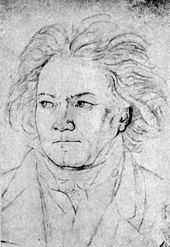
Beethoven in 1818 by August Klöber
Kaspar had been ill for some time, and Beethoven spent a small fortune in 1815 on his care. After Kaspar died on 15 November 1815, Beethoven immediately became embroiled in a protracted legal dispute with Kaspar's wife
Johanna over custody of their son
Karl (de), then nine years old. Beethoven, who considered Johanna an unfit parent because of her morals (she had an illegitimate child by a different father before marrying Kaspar and had been convicted of theft) and financial management, had successfully applied to Kaspar to have himself named sole guardian of the boy. A late
codicil to Kaspar's will gave him and Johanna joint guardianship. While Beethoven was successful at having his nephew removed from her custody in February 1816, the case was not fully resolved until 1820, and he was frequently preoccupied by the demands of the litigation and seeing to the welfare of Karl, whom he first placed in a private school.
The Austrian court system had one court for the
nobility and members of the
Landtafel, the
Landrechte, and many other courts for commoners, among them the Civil Court of the Vienna Magistrate. Beethoven disguised the fact that the Dutch "
van" in his name did not denote nobility as does the German "
von"
[79] and his case was tried in the Landrechte. Owing to his influence with the court, Beethoven felt assured of the favourable outcome of being awarded sole guardianship. While giving evidence to the Landrechte, however, Beethoven was unable to prove being of noble birth
[79] and as a consequence, on 18 December 1818 the case was transferred to the Magistracy, where he lost sole guardianship.
Beethoven appealed and regained custody. Johanna's appeal to the Emperor was not successful: the Emperor "washed his hands of the matter." During the years of custody that followed, Beethoven attempted to ensure that Karl lived to the highest moral standards. Beethoven had an overbearing manner and frequently interfered in his nephew's life. Karl attempted suicide on 31 July 1826 by shooting himself in the head. He survived and was brought to his mother's house, where he recuperated. He and Beethoven were reconciled, but Karl insisted on joining the army and last saw Beethoven in January 1827.
[80]
Late works
Beethoven began a renewed study of older music, including works by
J. S. Bach and
Handel, that were then being published in the first attempts at complete editions. He composed the overture
The Consecration of the House, which was the first work to attempt to incorporate these influences. A new style emerged, now called his "late period". He returned to the keyboard to compose his first piano sonatas in almost a decade: the works of the late period are commonly held to include the last five piano sonatas and the
Diabelli Variations, the last two sonatas for cello and piano, the late string quartets (see below), and two works for very large forces: the
Missa Solemnis and the
Ninth Symphony.
[citation needed]
By early 1818 Beethoven's health had improved, and his nephew moved in with him in January. On the downside, his hearing had deteriorated to the point that conversation became difficult, necessitating the use of conversation books. His household management had also improved somewhat; Nanette Streicher, who had assisted in his care during his illness, continued to provide some support, and he finally found a skilled cook. His musical output in 1818 was still somewhat reduced, but included song collections and the
"Hammerklavier" Sonata, as well as sketches for two symphonies that eventually coalesced into the epic Ninth. In 1819 he was again preoccupied by the legal processes around Karl, and began work on the
Diabelli Variations and the
Missa Solemnis.
[citation needed]
For the next few years he continued to work on the Missa, composing piano sonatas and
bagatelles to satisfy the demands of publishers and the need for income, and completing the Diabelli Variations. He was ill again for an extended time in 1821, and completed the Missa in 1823, three years after its original due date. He also opened discussions with his publishers over the possibility of producing a complete edition of his work, an idea that was arguably not fully realised until 1971.
[citation needed] Beethoven's brother Johann began to take a hand in his business affairs, much in the way Kaspar had earlier, locating older unpublished works to offer for publication and offering the Missa to multiple publishers with the goal of getting a higher price for it.
[citation needed]
Two commissions in 1822 improved Beethoven's financial prospects. The
Philharmonic Society of London offered a commission for a symphony, and Prince
Nikolas Golitsin of
St. Petersburg offered to pay Beethoven's price for three string quartets. The first of these commissions spurred Beethoven to finish the Ninth Symphony, which was first performed, along with the Missa Solemnis, on 7 May 1824, to great acclaim at the
Kärntnertortheater. The
Allgemeine musikalische Zeitung gushed, "inexhaustible genius had shown us a new world," and Carl Czerny wrote that his symphony "breathes such a fresh, lively, indeed youthful spirit ... so much power, innovation, and beauty as ever [came] from the head of this original man, although he certainly sometimes led the old wigs to shake their heads." Unlike his more lucrative earlier concerts, this did not make Beethoven much money, as the expenses of mounting it were significantly higher. A second concert on 24 May, in which the producer guaranteed Beethoven a minimum fee, was poorly attended; nephew Karl noted that "many people [had] already gone into the country." It was Beethoven's last public concert.
|
|
written between 1821 and 1822, during Beethoven's late period
|
| Problems playing this file? See media help. |

Beethoven in 1823 by Ferdinand Georg Waldmüller
Beethoven then turned to writing the string quartets for Golitsin. This series of quartets, known as the "
Late Quartets," went far beyond what musicians or audiences were ready for at that time. One musician
[who?] commented that "we know there is something there, but we do not know what it is." Composer
Louis Spohr called them "indecipherable, uncorrected horrors." Opinion has changed considerably from the time of their first bewildered reception: their forms and ideas inspired musicians and composers including
Richard Wagner and
Béla Bartók, and continue to do so. Of the late quartets, Beethoven's favourite was the
Fourteenth Quartet, op. 131 in C
♯ minor, which he rated as his most perfect single work.
[84] The last musical wish of
Schubertwas to hear the Op. 131 quartet, which he did on 14 November 1828, five days before his death.
[85]
Beethoven wrote the last quartets amidst failing health. In April 1825 he was bedridden, and remained ill for about a month. The illness—or more precisely, his recovery from it—is remembered for having given rise to the deeply felt slow movement of the
Fifteenth Quartet, which Beethoven called "Holy song of thanks ('Heiliger Dankgesang') to the divinity, from one made well." He went on to complete the quartets now numbered
Thirteenth,
Fourteenth, and
Sixteenth. The last work completed by Beethoven was the substitute final movement of the Thirteenth Quartet, which replaced the difficult
Große Fuge. Shortly thereafter, in December 1826, illness struck again, with episodes of vomiting and diarrhoea that nearly ended his life.
[citation needed]
Illness and death
Beethoven was bedridden for most of his remaining months, and many friends came to visit. He died on 26 March 1827 at the age of 56 during a thunderstorm. His friend
Anselm Hüttenbrenner, who was present at the time, said that there was a peal of thunder at the moment of death. An
autopsy revealed significant
liver damage, which may have been due to heavy alcohol consumption. It also revealed considerable dilation of the auditory and other related nerves.
[89]
Beethoven's funeral procession on 29 March 1827 was attended by an estimated 20,000 Viennese citizens.
Franz Schubert, who died the following year and was buried next to Beethoven, was one of the torchbearers. Beethoven was buried in a dedicated grave in the
Währing cemetery, north-west of Vienna, after a requiem mass at the church of the Holy Trinity (Dreifaltigkeitskirche). His remains were
exhumed for study in 1862, and moved in 1888 to Vienna's
Zentralfriedhof. In 2012, his crypt was checked to see if his teeth had been stolen during a series of grave robberies of other famous Viennese composers.
[90]
Music

A bust by
Hugo Hagenbased upon Beethoven's life mask
Beethoven is acknowledged as one of the giants of
classical music; he is occasionally referred to as one of the "
three Bs" (along with
Bach and
Brahms) who epitomise that tradition. Without abandoning the fundamental tenets of 18th century musical
Classicism himself, he nonetheless pointed the way towards 19th century
Romanticism by means of paradigm-shifting artistic innovation, and his influence on subsequent generations of composers was profound.
[96] His music features twice on the
Voyager Golden Record, a phonograph record containing a broad sample of the images, common sounds, languages, and music of Earth, sent into outer space with the two
Voyager probes.
[97]
Overview
Beethoven composed in several musical genres and for a variety of instrument combinations. His works for
symphony orchestra include nine
symphonies (of which the Ninth Symphony includes a chorus), and about a dozen pieces of "occasional" music. He wrote seven
concerti for one or more soloists and orchestra, as well as four shorter works that include soloists accompanied by orchestra. His only
opera is
Fidelio; other vocal works with orchestral accompaniment include two
masses and a number of shorter works.
His large body of compositions for
piano includes 32
piano sonatas and numerous shorter pieces, including arrangements of some of his other works. Works with piano accompaniment include 10 violin sonatas, 5 cello sonatas, and a sonata for
French horn, as well as numerous
lieder.
The three periods
Beethoven's compositional career is usually divided into early, middle, and late periods.
[96] In this scheme, his early period is taken to last until about 1802, the middle period from about 1803 to about 1814, and the late period from about 1815.
[citation needed]
In his early period, Beethoven's work was strongly influenced by his predecessors
Haydn and
Mozart. He also explored new directions and gradually expanded the scope and ambition of his work. Some important pieces from the early period are the
first and
second symphonies, the set of six string quartets
Opus 18, the first two piano concertos, and the first dozen or so
piano sonatas, including the famous
Pathétique sonata, Op. 13.
His middle (heroic) period began shortly after Beethoven's personal crisis brought on by his recognition of encroaching deafness. It includes large-scale works that express heroism and struggle. Middle-period works include six symphonies (Nos. 3–8), the last three piano concertos, the
Triple Concerto and
violin concerto, five string quartets (Nos. 7–11), several piano sonatas (including the
Moonlight,
Waldstein and
Appassionata sonatas), the
Kreutzer violin sonata and Beethoven's only
opera,
Fidelio.
Beethoven's late period began around 1815. Works from this period are characterised by their intellectual depth, their formal innovations, and their intense, highly personal expression. The
String Quartet, Op. 131 has seven linked movements, and the
Ninth Symphony adds choral forces to the orchestra in the last movement.
[96] Other compositions from this period include the
Missa Solemnis, the last five string quartets (including the massive
Große Fuge) and the last five piano sonatas.
Character
Beethoven's personal life was troubled by his encroaching
deafness and irritability brought on by chronic abdominal pain (beginning in his twenties), which led him to contemplate suicide (documented in his
Heiligenstadt Testament). Beethoven was often irascible. It has been suggested he had
bipolar disorder.
[98] Nevertheless, he had a close and devoted circle of friends all his life, thought to have been attracted by his strength of personality. Towards the end of his life, Beethoven's friends competed in their efforts to help him cope with his incapacities.
[96]
Sources show Beethoven's disdain for authority and for social rank. He stopped performing at the piano if the audience chatted amongst themselves, or afforded him less than their full attention. At soirées, he refused to perform if suddenly called upon to do so. Eventually, after many confrontations, the Archduke Rudolph decreed that the usual rules of court etiquette did not apply to Beethoven.
[96]
Beethoven was attracted to the ideals of the
Age of Enlightenment. In 1804, when Napoleon's imperial ambitions became clear, Beethoven took hold of the title page of his
Third Symphony and scratched the name Bonaparte out so violently that he made a hole in the paper. He later changed the work's title to "Sinfonia Eroica, composta per festeggiare il sovvenire d'un grand'uom" ("Heroic Symphony, composed to celebrate the memory of a great man"), and he rededicated it to his patron, Prince Joseph Franz von Lobkowitz, at whose palace it was first performed.
[citation needed]
The fourth movement of his
Ninth Symphony features an elaborate choral setting of
Schiller's Ode
An die Freude ("Ode to Joy"), an optimistic hymn championing the brotherhood of humanity.
In popular culture
Beethoven has been the subject of a number of biographical films; see
Beethoven in film.
Beethoven's Tenth is a play in two acts by actor
Peter Ustinov. The first performances in the US were between 7 October and 27 November 1983, with Ustinov himself playing the leading role and supporting actors including
George Rose.
[99]
Legacy
The
Beethoven Monument, Bonn, was unveiled in August 1845, in honour of his 75th anniversary. It was the first statue of a composer created in Germany, and the music festival that accompanied the unveiling was the impetus for the very hasty construction of the original
Beethovenhalle in Bonn (it was designed and built within less than a month, on the urging of
Franz Liszt). A statue to Mozart had been unveiled in
Salzburg, Austria in 1842. Vienna did not honour Beethoven with a statue until 1880.
[100] His is the only name inscribed on one of the plaques that trim
Symphony Hall, Boston; the others were left empty because it was felt that only Beethoven's popularity would endure.
[101]
There is a museum, the
Beethoven House, the place of his birth, in central Bonn. The same city has hosted a musical festival, the
Beethovenfest, since 1845. The festival was initially irregular but has been organised annually since 2007.


